Use the Same Means that God Used in Coming Down to Us
If we wish to go to God, seeking union with him, we must use the same means that he used in coming down from heaven to us. This does not mean that one who has discovered Mary through a genuine devotion is exempt from crosses and sufferings. Far from it! One is tried even more than others, because Mary, as Mother of the living, gives to all her children splinters of the tree of life, which is the Cross of Jesus. But while meting out crosses to them she gives the grace to bear them with patience, and even with joy. In this way, the crosses she sends to those who trust themselves to her are rather like sweetmeats, i.e. "sweetened" crosses rather than "bitter" ones. If from time to time they do taste the bitterness of the chalice from which we must drink to become proven friends of God, the consolation and joy which their Mother sends in the wake of their sorrows creates in them a strong desire to carry even heavier and still more bitter crosses.
The difficulty, then, is how to arrive at the true knowledge of the most holy Virgin and so find grace in abundance through her. God, as the absolute Master, can give directly what he ordinarily dispenses only through Mary, and it would be rash to deny that he sometimes does so. However, St Thomas assures us that, following the order established by his divine Wisdom, God ordinarily imparts his graces to men through Mary. Therefore, if we wish to go to him, seeking union with him, we must use the same means that he used in coming down from heaven to assume our human nature and to impart his graces to us. That means was a complete dependence on Mary his Mother, which is true devotion to her.
Saint Louis Grignion de Montfort
The Secret of Mary 22-23
| ||

Sunday, April 28, 2013
Saint Louis Grignion de Montfort

Thursday, April 25, 2013
The Eucharist Leads Us to the Magnificat
In the Eucharist the Church is completely united to Christ and his sacrifice, and makes her own the spirit of Mary. This truth can be understood more deeply by re-reading the Magnificat in a Eucharistic key.
The Eucharist, like the Canticle of Mary, is first and foremost praise and thanksgiving. When Mary exclaims: “My soul magnifies the Lord and my spirit rejoices in God my Savior,” she already bears Jesus in her womb. She praises God “through” Jesus, but she also praises him “in” Jesus and “with” Jesus. This is itself the true “Eucharistic attitude.” At the same time Mary recalls the wonders worked by God in salvation history in fulfilment of the promise once made to the fathers (cf. Lk 1:55), and proclaims the wonder that surpasses them all, the redemptive incarnation. Lastly, the Magnificat reflects the eschatological tension of the Eucharist. Every time the Son of God comes again to us in the “poverty” of the sacramental signs of bread and wine, the seeds of that new history wherein the mighty are “put down from their thrones” and “those of low degree are exalted” (cf. Lk 1:52), take root in the world. Mary sings of the “new heavens” and the “new earth” which find in the Eucharist their anticipation and in some sense their programme and plan. The Magnificat expresses Mary's spirituality, and there is nothing greater than this spirituality for helping us to experience the mystery of the Eucharist. The Eucharist has been given to us so that our life, like that of Mary, may become completely a Magnificat!
John Paul II
Excerpt of: John Paul II, Encyclical Letter Ecclesia de
Eucharistia 2003 58
| ||
Monday, April 22, 2013
Consecrated to Mary
The More One is Consecrated to Mary, the More one is Consecrated to Jesus
“As all perfection consists in our being conformed, united and consecrated to Jesus it naturally follows that the most perfect of all devotions is that which conforms, unites, and consecrates us most completely to Jesus.
Now of all God's creatures Mary is the most conformed to Jesus. It therefore follows that, of all devotions, devotion to her makes for the most effective consecration and conformity to him. The more one is consecrated to Mary, the more one is consecrated to Jesus. That is why perfect consecration to Jesus is but a perfect and complete consecration of oneself to the Blessed Virgin, which is the devotion I teach; or in other words, it is the perfect renewal of the vows and promises of holy baptism.” (TD 120)
Saint Louis Grignion de Montfort (1673-1716)
| |
Sunday, April 21, 2013
ENDURING ALL PART I
All Grievous Things Are to Be Endured For Eternal Life
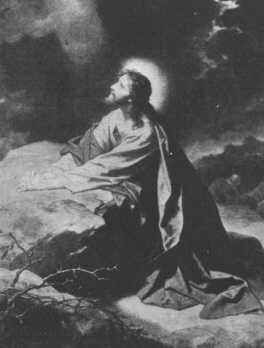
Son, be not dismayed with the labors which thou hast undertake for Me, neither let tribulations ever cast thee down; but let My promise strengthen thee, and comfort thee in ever event. PS CXVIII. 71
I am sufficient to reward thee beyond all measure. GEN XV 1
Thou shalt not labor here long, nor shalt thou be always oppressed with sorrows.
Wait a little while and thou shalt see a speedy end of all they evils.
The hour will come when labor and trouble shall be no more.
All is little and short which passeth away with time WIS III 9
Do thy part well; mind what thou art about; labor faithfully in My vineyard, I will be they reward.
Write, read, sing sigh, keep silence, pray, bear thy crosses manfully; eternal life is worthy of all these, and greater combats.
Peace shall come in one day, which is known to the Lord; and it shall not be a vicissitude of day and night,k such as is at present; but everlasting light, infinite brightness, steadfast peace, and secure rest. APOC XXI 23
Thou shalt not then say: Who shall deliver me from the body of this death? ROM VII 24. Nor shalt thou cry out: Woe is me, that my sojourning is prolonged. PS CXIX 5 For death shall be no more, but never-failing health: no anxiety, but blessed delight, and a society sweet and lovely.
Oh, if thou hadst seen the everlasting crown of the saints in heaven, and in how great glory they now triumph who appeared contemptible heretofore to this world, and in a manner even unworthy of life, doubtless thou wouldst immediately cast thyself down to the very earth, and wouldst rather seek to be under the feet of all, than to have command over so much as one.
My Imitation of Christ (Ch 47)
Saturday, April 20, 2013
TRUE FRIENDSHIP

The Believer
A FAITHFUL friend, says Scripture, is a rich treasure.
That gift is given only to those who fear the Lord.(Sir 6:14, 17).
Mary, God enabled you to find that priceless treasure in
Elizabeth, and she found it in you.
Each of you provides a model of perfect friendship, of holy
friendship that was free of all that corrupts human
friendship.
A happy similarity of sentiments-religious sentiments-
linked you together. Grace and virtue were the gifts
you valued in Elizabeth and the gifts she valued in you.
You spoke frequently to each other, confided in each
other, offered each other advice, and competed in
serving each other. But all the proofs of friendship
which you offered each other had a single ultimate
purpose: the glorification of God.
Elizabeth must have seen that, after she had become
united in spirit to you, her relationship to God
was deeper than before.
You, holy Virgin, made the same progress in holiness
while in your cousin's house that you would have
made in the solitude of Nazareth.
You were content with the union between you and
broke off your visit without ceasing to love each
other. The virtue that unites two hearts cannot
fall victim to inconstancy.
The Imitation of Mary (Ch 27)
Friday, April 19, 2013
Why Should I Answer the Call of My Heart?
What motive do I have to answer the call of my heart, when by a movement of sincere piety and joyous admiration it wants to greet a young girl from Bethlehem as the woman who is blessed among all women? She is the mother of the Lord, the mother of my Lord. This is the deepest reason for my veneration and gratitude to her. Already on a natural level, an incomparable light surrounds the name “Mother” with a halo. As for authentic human sentiments, the title of “Mother” and all that it contains and signifies evokes something sacred and inviolable. The very name of Mother contains all that is most tender and pure in a person's life. Would you be able to depreciate your mother or speak ill of her? Would you want to erase her image from your soul? This is why it seems obvious to me that if Jesus is dear to us as our Lord and Savior, it is natural for us to have warm and deep feelings for the woman he used to call his Mother, his own Mother. To honor him and despise his Mother, to glorify him and belittle his Mother is not consistent if we see Jesus as the true son of Mary, the Virgin of the city of David, something we do in fact each time we recite the Apostles' Creed: “I believe in Jesus Christ born of the Virgin Mary”. Herrens Moder (The Mother of the Lord – Variations on the Magnificat), Uppsala 1929 Quoted by Benoît Thierry d'Argenlieu, Marie Reine du Nord, In: Maria – études sur la Vierge Marie – under the direction of Hubert du Manoir, S. J. - Volume IV, 1956 | ||
Wednesday, April 17, 2013
"Give Us the Lady..."
There used to be a missionary priest who recited his rosary while hiking on the peaks behind Dalat in Vietnam. He probably prayed it very well, for the Virgin Mary listened well... This is what happened:
The priest, who had learned the Moï dialect, met a wounded child, nursed him back to health and took him home to his village, where he forged a friendship with the boy’s tribe... When the “friendship” was considered strong enough, the chief uttered this mysterious request: “Give us the Lady.” What Lady? The one that can be seen in the church in Dalat... Between noon and two o’clock in the afternoon, when the market place was deserted, the mountain people who had come to the market discretely slipped in the big house and there, stunned with admiration, they stood speechless in front of “the Lady.” The priest prepared his first instructions and demands for sacrifices around this primitive desire, and finally one day it was decided that the Lady could come to them... Try to imagine the commotion: the village was scrubbed clean, a hut was built for the Lady, and fresh palm leaves were cut in the forest. Musicians, with their gongs and khens, walked down the road to meet the statue. The women put on their best clothes... Further down, in Dalat, the hill country also was exuberant. The convent prepared a large statue, decorated the stretcher with flowers, and invited all the other schools. A long procession of young people wound through the mountains. People said the rosary, singing in different languages, along the red clay path. At one point, they even had to cross a torrent on a monkey bridge! Finally, they received a moving welcome from the “village-who-loves-Mary,” with blessings, the exchange of necklaces and bracelets in signs of friendship, offerings, the celebration of Mass with the recitation of the Pater in Latin, French and Moï. The youth all picnicked together and returned home joyfully. “It is only a good-bye, my brothers.”
Canonesses of Saint Augustine
The Route of Our Lady in Viet Nam, January 1954
In: Maria-under the direction of Hubert du Manoir, S.J.-Volume IV 1956
| ||
Subscribe to:
Posts (Atom)